Baba Yaga: The Iron-Toothed Witch of the Woods
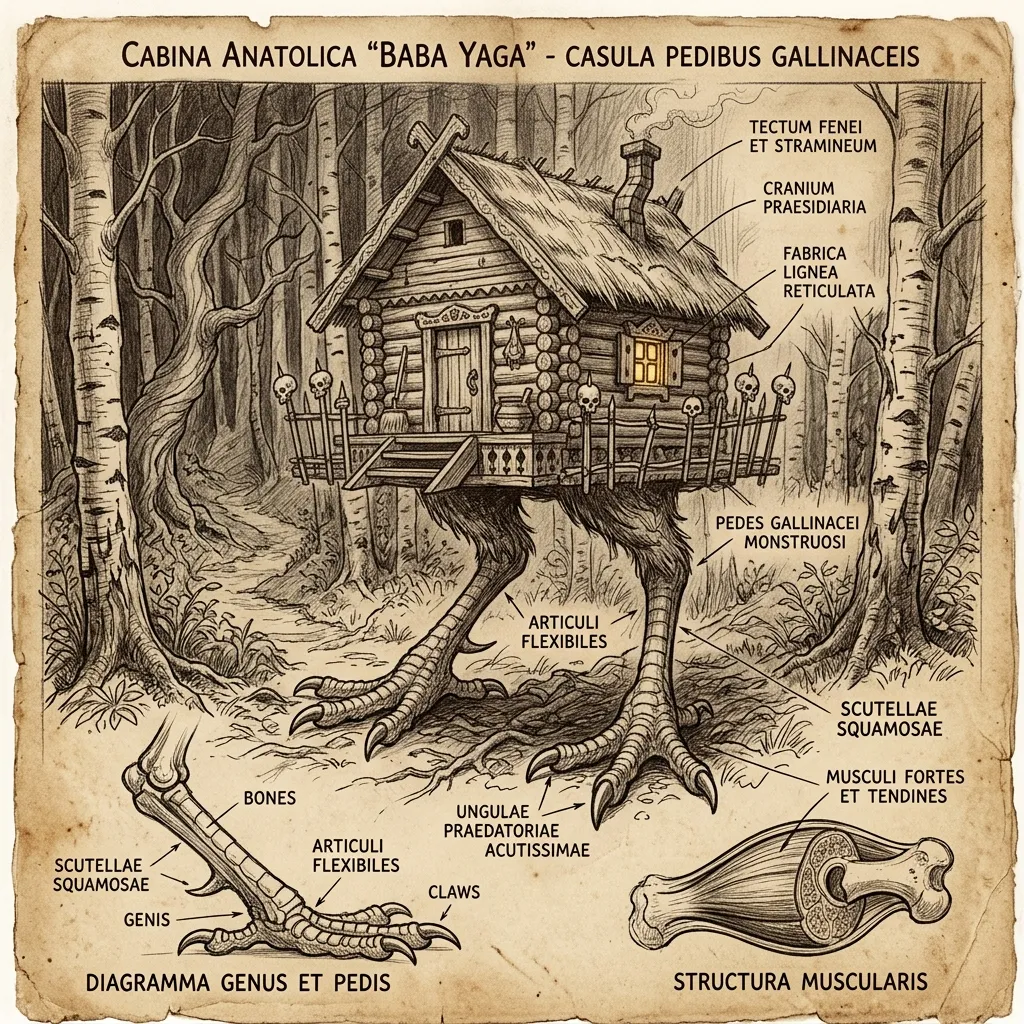
The Hut on Chicken Legs
A Page from the Beastkeeper’s Journal
The birch forest was so dense that twilight seemed to last all day. The trees were bone-white, their black scars looking like hundreds of unblinking eyes watching my progress. I had been walking for hours, losing the trail twice, guided only by an old map and the unsettling feeling that the woods were closing in behind me.
Then, the smell hit me. Rotting wood, crushed herbs, and something metallic—like blood.
Through a break in the trees, I saw a clearing surrounded by a fence made entirely of human bones, topped with glowing skulls. And in the center stood the hut. It didn't rest on the ground; it swayed slightly, balanced on two massive, scaly chicken legs that occasionally shifted their weight, claws digging into the dirt.
Origins of the Forest Hag
Baba Yaga is one of the most complex and fearsome figures in Slavic folklore. She is an ancient witch, a manifestation of the wild, untamable forces of nature. Unlike Western fairy-tale witches who are purely evil, Baba Yaga is ambiguous. She can be a cannibalistic monster who roasts children in her oven, or a wise crone who aids heroes—if they prove themselves worthy.
She does not ride a broomstick. Instead, she flies through the air in a giant mortar, steering it with a pestle, and sweeping away her tracks behind her with a broom made of silver birch.
Journal Note:
She isn't just a witch; she is the forest itself. Chaotic, dangerous, providing life to some and death to others. To seek her out is to ask the wilderness to judge you.
The House That Moves
Baba Yaga's dwelling is as famous as she is. The hut on chicken legs (Izbushka) is alive. It spins and moves through the forest, making it impossible to find unless the hut wishes to be found.
To enter, one must speak a specific incantation: "Hut, hut, turn your back to the forest and your front to me." Without this, there is no door to be found, only solid timber. The fence of glowing skulls outside provides her light, their empty eye sockets blazing with an eerie, magical fire.
Vasilisa the Beautiful
The most famous tale of Baba Yaga involves a young girl named Vasilisa, who was sent into the dark woods by her wicked stepmother to fetch a light from the witch—a task meant to be a death sentence.
Vasilisa found the bone fence and the walking hut. Baba Yaga, with her long nose touching the ceiling and her iron teeth gleaming, assigned the girl impossible, back-breaking chores: sorting poppy seeds from dirt, and washing mounds of laundry. Thanks to a magical wooden doll left to her by her deceased mother, Vasilisa completed the tasks.
Impressed by the girl's pure heart and magical aid, Baba Yaga didn't eat her. Instead, she gave Vasilisa one of the glowing skulls from the fence. When Vasilisa returned home, the skull's fiery eyes burned her cruel stepmother and stepsisters to ashes.
Journal Note:
Baba Yaga's justice is brutal and absolute. She doesn't care for human morality; she respects strength, cunning, and respect for the natural order.
A Final Reflection
I crouched behind a thick birch, watching the hut shift its weight. I didn't speak the incantation. I didn't step into the clearing. I had come to see if the legend was real, and the glowing skulls were answer enough. I slowly backed away, careful not to snap a single twig, praying I could find my way out of the woods before I heard the grinding of a giant mortar and pestle in the sky above.
Did You Know?
Baba Yaga is often referred to as "Baba Yaga Bony-Legs," because her legs are said to be stripped of flesh, revealing her connection to death and the underworld.
<div className="bg-surface border border-gray-700 rounded-lg p-6 my-8 text-center shadow-lg"> <h3 className="text-xl font-bold text-white mb-2">Want the Hut on your tabletop?</h3> <p className="text-content-dim mb-4">Support our expedition by grabbing the exclusive 3D printable STL figurine.</p> <a href="#fake-door-stl-babayaga" className="inline-block bg-blue-600 hover:bg-blue-500 text-white font-bold py-2 px-6 rounded-full transition-colors"> Download 3D Printable STL (Free) </a> </div>