A Day in the Life: The Drop Bear
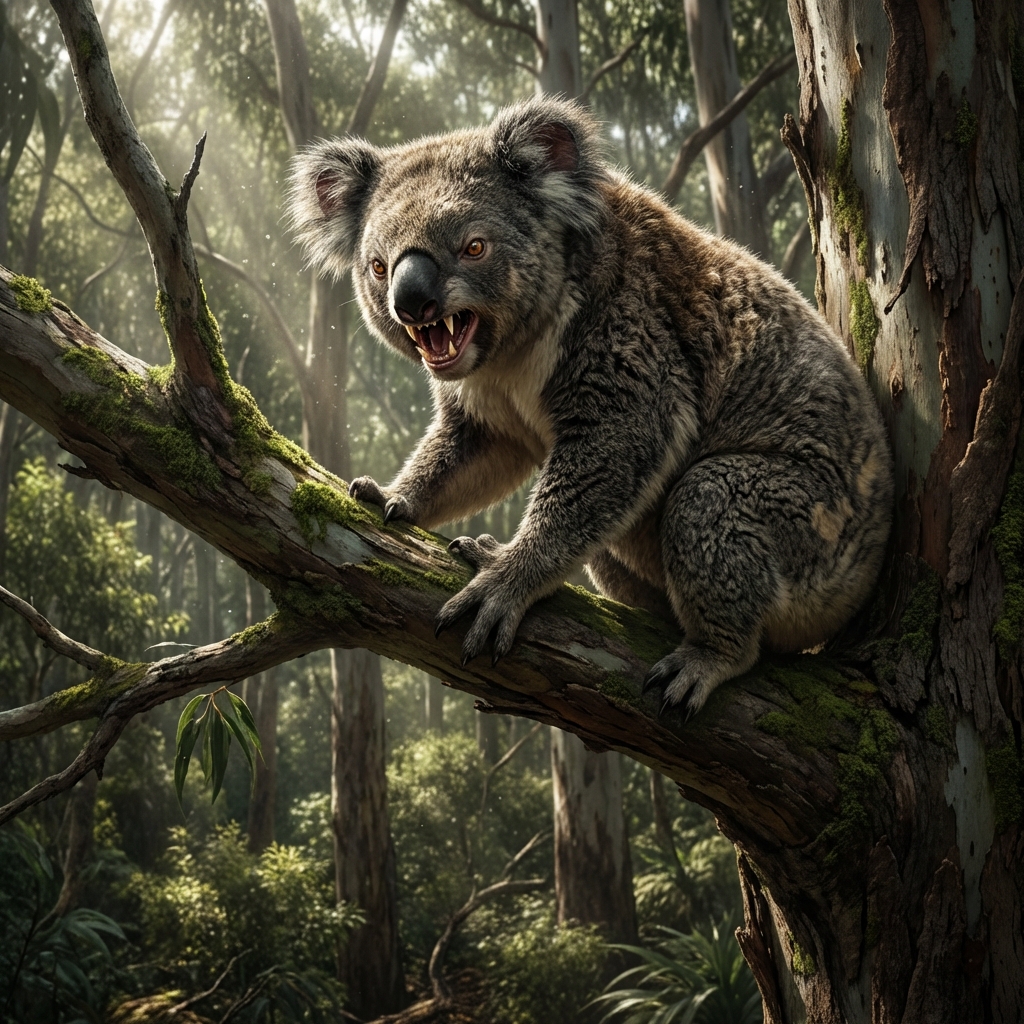
The Grey Ghost
The Australian bush is never truly quiet. Even before dawn, there is the rustle of wallabies in the undergrowth and the eerie call of the mopoke owl.
High above the ground, sixty feet up in the fork of a massive Grey Gum, a shape shifts.
To the untrained eye, it looks like a koala. A very large, very ugly koala.
The Drop Bear wakes.
Uncurling its body, it reveals a predator the size of a leopard. Its fur is coarse and mottled grey, blending perfectly with the bark of the eucalyptus. Its ears are tufted, but its face—distinct from its herbivorous cousins—tells a darker story. The jaw is heavier. The eyes are predatory, facing forward for binocular vision.
And the teeth. Two inch-long canines protrude from the upper lip, designed not for chewing leaves, but for piercing skulls.
It yawns, scratching a patch of mange on its flank with a claw that looks like a grappling hook. It hasn't eaten in three days.
The Trap
The sun rises, baking the oils in the eucalyptus leaves until the air smells medicinal and sharp. The heat begins to build.
The Drop Bear moves. It does not climb like a koala, hugging the trunk; it leaps from branch to branch with fluid, muscular grace. Testing the wind, it searches for a specific type of location. A "kill zone."
It finds it above a hiking trail. The path below is narrow, flanked by dense scrub. Humans walking here will be forced into single file, looking down at their feet to avoid snakes and roots. They will not be looking up.
The beast settles onto a thick branch directly over the path. Pressing itself flat against the wood, its mottled fur breaks up its outline. It becomes a knot in the wood, a shadow, a part of the tree itself.
It waits.
This is the ultimate patience. Slowing its breathing and dropping its heart rate, it enters a state of near-suspended animation. It can wait like this for hours.
The Tourist
Voices.
They carry far in the dry air. The Drop Bear’s ears swivel. German accents. Heavy boots crunching on gravel.
A group of three hikers approaches. They are loud. They are wearing bright colours. They have no idea they are walking into a carnivorous living room.
The lead hiker stops right below the tree. He adjusts his backpack, wipes sweat from his forehead, and takes a drink from a water bottle.
The Drop Bear tenses. Its muscles coil like steel springs. It calculates the distance: sixty feet. A two-second freefall.
It shifts its weight.
But the hiker moves. He starts walking again. "Komm schon!" he yells to his friends.
The moment is lost. The Drop Bear relaxes. It does not attack moving targets if it can avoid it; the success rate is too low. It needs a stationary target. It needs certainty.
Watching them walk away, it feels no frustration. Only the cold calculation of a machine designed to kill.
The Shift
The heat is intense. The bush flies are swarming.
The Drop Bear decides to move. This tree has yielded no food.
It descends, moving down the trunk head-first, claws digging deep into the hardwood. When it reaches the ground, it is awkward; unlike its canopy grace, its legs are built for grasping, not running. It scuttles across the forest floor with a heavy, rolling gait.
A dingo trots out of the scrub. The wild dog freezes. It sees the Drop Bear.
Usually, a dingo would chase a koala. But it looks at this creature. It sees the size of the shoulders. It sees the glint of the teeth.
The dingo whines low in its throat and turns tail, trotting away briskly. It wants no part of this.
The Drop Bear reaches a new tree. A Blue Gum with smooth, pale bark. It scrambles up, shreds of bark flying under its claws. Climbing higher, it becomes a dark speck against the bright sky.
This spot is better. It is near a clearing where kangaroos graze at dusk.
Gravity
The sun sets in a blaze of orange and pink. The temperature drops rapidly.
A solitary kangaroo comes out to graze. It is a large male, a Red. It hops slowly, oblivious.
It stops beneath the Blue Gum to scratch its ear.
This is it.
The Drop Bear does not hesitate. It releases its grip.
There is no sound. No growl. Just the rush of air.
Gravity does the work.
The beast falls sixty feet. It is a missile of muscle and fur.
Impact.
The sound is a sickening crunch. The Drop Bear lands squarely on the kangaroo’s shoulders. The force of the impact alone stuns the prey, perhaps cracking its spine. Before the kangaroo can even process the shock, the Drop Bear bites. The long canines sink into the base of the skull.
The kangaroo spasms once, then goes limp.
The Drop Bear rides the falling body to the ground. It rolls off, shaking the dust from its coat.
Standing over its kill, it looks around the darkening bush with glowing eyes.
The legends say they only attack tourists. The legends say spreading Vegemite behind your ears will repel them.
The Drop Bear knows nothing of Vegemite. It knows only the weight of the fall, the crunch of the bone, and the warmth of the meat.
It begins to drag the carcass toward the tree. It will be a good night.