Labyrinth Solitude with the Minotaur
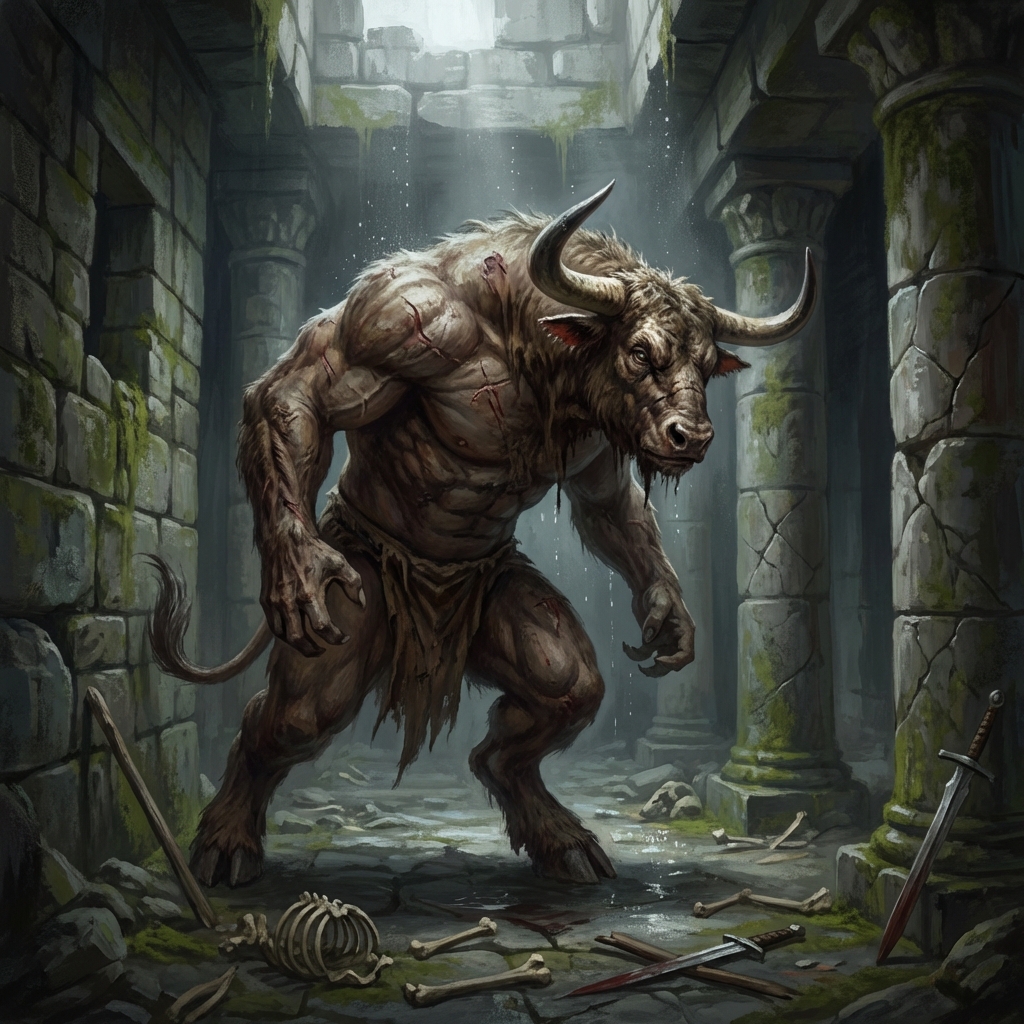
The Endless Stone
There is no sunrise in the Labyrinth. There is only the grey light that filters down from distant shafts, illuminating dust motes dancing in the stagnated air. The Minotaur wakes on a bed of straw and bones. Groaning, he stretches his massive, bovine neck, and the sound echoes down the corridor, bouncing off the limestone walls until it fades into nothing.
He is Asterion, the Starry One. He is the son of Queen Pasiphae and the Cretan Bull. He is a prince of Crete, yet his palace is a prison designed by the genius Daedalus to be inescapable. Standing, he scrapes his horns against the low ceiling. He is enormous, a mountain of muscle and fur. His head is that of a bull, wet-nosed and wide-eyed, but his body is the body of a man stretched to monstrous proportions.
He begins walking. He does not know where he is going. The Labyrinth has no center and no exit. It is a mathematical impossibility made of stone.
The Hunger
A dull ache radiates from his stomach. It has been weeks since the last tribute. Athens sends seven youths and seven maidens every nine years, but the intervals between feasts feel like centuries. He sniffs the air. It smells of damp stone and old fear. There is no scent of fresh blood today.
Hunger makes him irritable. He punches the wall, and the stone cracks. His strength is a curse. It serves no purpose here but to destroy the only thing he has—his cage. He remembers the taste of the last youth; the boy had screamed, running down a dead-end corridor. The Minotaur had felt a flicker of pity, quickly extinguished by the overwhelming, red haze of instinct. He is not a cannibal by choice. He is a cannibal by design. The gods made him this way.
The Sound of Footsteps
He freezes. His ears, large and tufted with fur, twitch. Tap. Tap. Tap. It is not the sound of water dripping. It is the sound of sandals on stone. Someone is here.
He exhales, a snort that blasts dust from the floor. The Red Haze begins to descend. The man, Asterion, recedes. The Bull takes over. He lowers his head and begins to run. The corridors blur as he navigates turns by heart or instinct. Left, right, straight, left. The sound of footsteps grows louder. He rounds a corner and sees him. An intruder. Not a tribute, but a warrior holding a sword and a ball of string.
The Encounter
The warrior sees the monster. He does not scream; he raises his shield. The Minotaur roars—a sound of pure fury, a release of all the pent-up loneliness and rage of his confinement. He charges.
The impact is like a battering ram hitting a gate. The warrior is thrown back, skidding across the flagstones, but he is quick. He rolls and slashes. Pain flares in the Minotaur's leg. He bellows, kicking out with a hoof, but the warrior dodges. This is new. The tributes usually cower. This one fights.
They circle each other in the gloom. The Minotaur feels a strange sensation. It is not just anger. It is excitement. Finally, a challenge. Finally, something other than the silence.
The Retreat
The warrior is smart. He uses the narrow corridors to his advantage, staying out of reach of the massive horns. He strikes and retreats, strikes and retreats. The Minotaur is bleeding. The Red Haze wavers. He realizes he cannot win this way. He needs to ambush.
He turns and flees. It is a feint. He knows a shortcut, a hidden passage that will bring him behind the intruder. He thunders away, his hooves striking sparks from the floor, and hears the warrior shouting, claiming victory. Let him think he has won, the Minotaur thinks. The Labyrinth is my body. He is just a virus.
The Long Wait
He crouches in the shadows of a cross-junction, waiting. His breath comes in ragged gasps. The pain in his leg is sharp, grounding him. But hours pass. The warrior does not come this way. Perhaps he found another path? Or perhaps he is simply lost, another victim of Daedalus’s geometry.
The Minotaur rests his head against the cold stone. The excitement fades, replaced by the crushing weight of solitude. He is alone again. He closes his eyes. In the darkness, he is not a monster. He is a prince playing in the gardens of Knossos. He can smell the sea. He can feel the sun. But when he opens his eyes, there is only the grey stone. And the hunger. Always the hunger. He stands up and begins to walk again. Left, right, straight, left.