Black Shuck: The Demon Dog
The Incident at Bungay
On August 4, 1577, a violent storm struck the coast of East Anglia. At St. Mary's Church in Bungay, the congregation was gathered for morning prayer. Suddenly, the doors were breached not by wind, but by a biological entity.
Witnesses described a black canine, roughly the size of a cart-horse, moving with supernatural speed down the nave. It killed two men instantly, wringing their necks like birds, before vanishing. The same entity appeared miles away at Blythburgh Church later that day, causing the steeple to collapse. The north door still bears deep, cauterized claw marks. It was not lightning. It was Black Shuck.
The King of Hellhounds
Shuck is the apex predator of the British spectral ecosystem. He patrols the coastal paths, fenlands, and graveyards of Norfolk and Suffolk.
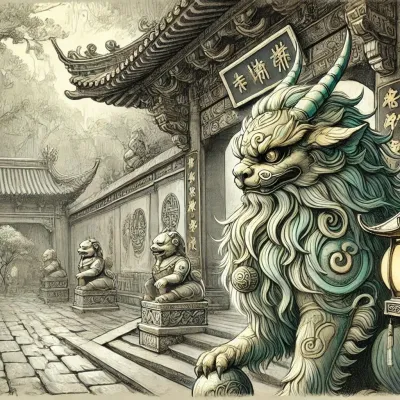
His physiology is terrifyingly distinct. He is described as a massive, shaggy beast with malevolent intelligence. His most defining feature is his ocular structure—witnesses report either two glowing red eyes or a single, cyclopean eye burning in the center of his forehead like a lantern. He makes no sound when he runs. His paws leave no tracks on the gravel.
Interaction Protocols
Encounters with Shuck abide by a strict set of rules.
- The Omen: Shuck is not always a combatant. Often, he is an observer. Meeting his gaze is considered a terminal diagnosis. Those who lock eyes with the beast are destined to die within a year.
- The Escort: Solitary travelers on the coastal roads often report a large dog walking parallel to them in the shadows. If acknowledged, the beast attacks. If ignored, he acts as a terrifying bodyguard, ensuring no other harm comes to the traveler.
- The Storm: His appearance almost always correlates with severe electrical storms.
Physical Evidence
The physical record supports the historical accounts. In 2014, archaeologists at Leiston Abbey excavated the skeleton of a massive dog, standing 7 feet tall on its hind legs, buried in a shallow grave. The radio-carbon dating places it near the time of the Bungay attack.
The Final Warning
The storm has passed, but the smell of ozone and wet fur remains in the air. If footsteps are heard behind you on a lonely road, do not turn around. Do not look for the source of the heavy, wet breathing; keep walking.