Kraken: The Living Island
The Titan of the Deep
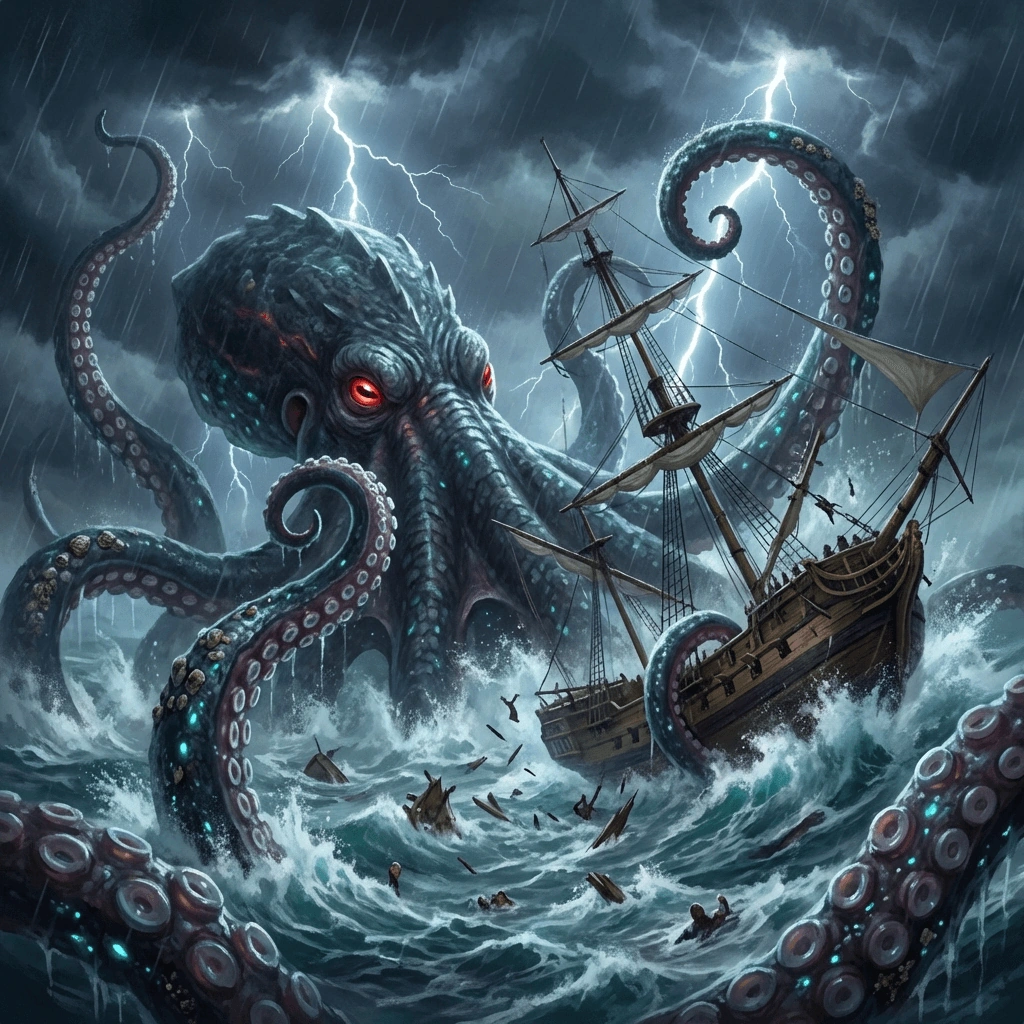
The Kraken is the legendary leviathan of the Nordic seas. First described in detail by Bishop Pontoppidan in the 18th century, it is not simply a "large squid." It is a creature of geographical scale. It was frequently mistaken for a chain of islands. Sailors would drop anchor on its back and make camp, only to drown when the "land" submerged. It represents the absolute indifference of the ocean.
The Maelstrom
The Kraken's primary weapon is displacement. While it possesses tentacles strong enough to crush the hull of a Man-of-War, it rarely needs to use them. When a creature of this magnitude dives, it creates a massive vacuum on the surface. This results in a whirlpool (maelstrom) that drags everything within a mile radius down to the abyss. Escaping the arms is possible. Escaping the physics of distinct displacement is not.
The Bait
Fishermen historically had a complex relationship with the Kraken. The creature emits a scent and excretes nutrients that attract massive schools of fish. To fish "over the Kraken" was to guarantee a record catch. It was the ultimate gamble: high reward, with the risk of total annihilation. If the water suddenly becomes shallow, or starts to bubble... the gamble has failed.
Cryptozoology
The myth is almost certainly rooted in sightings of the Giant Squid (Architeuthis dux) or the Colossal Squid (Mesonychoteuthis hamiltoni). While these animals "only" reach 40-50 feet, in the terror of a storm, or seen through the distortion of water and fear, they become monsters of island-sized proportions.
The Final Warning
The map ends for a reason. If you see an island that wasn't there yesterday, do not land; stay in deep water.
Featured Creature Profile
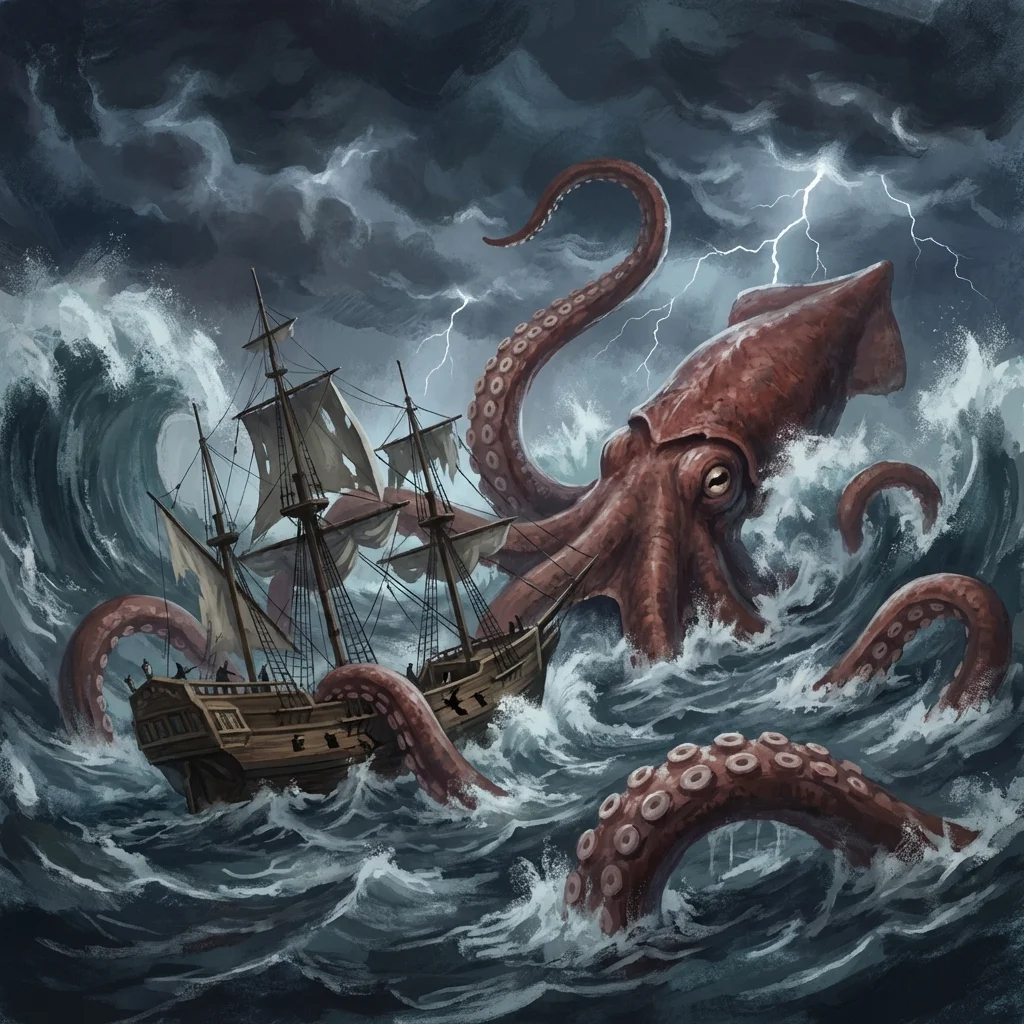
Kraken
Kraken is a hostile sea monster — a titanic cephalopod of deep-water habit, known from Scandinavian and sailors' tales. In the field I note its hull‑shaking presence before the creature is seen: a pattern of barnacled, rope‑like musculature beneath rubbery skin, enormous tapering arms tipped with concentric suckers, and an overall bulk that moves like a living current. Smell: a dense, oily brine with a metallic tang and the faint sweetness of decaying kelp. Sound: low, resonant groans that travel through timbers and a wet, drawing crackle as tentacles engage foreign surfaces; seafowl go silent when the tone lowers. Temperature: the water immediately around it registers a strange, living warmth — not hot, but a heat that makes skin prickle, as if the sea itself is breathing.