Loch Ness Monster: The Shadow in the Water
The Queen of the Highlands
Nessie is the world's most famous cryptid. She inhabits Loch Ness in the Scottish Highlands, a body of water that contains more fresh water than all the lakes in England and Wales combined. The Loch is 23 miles long and over 700 feet deep, with visibility near zero due to peat content. It is a geological scar that could easily hide a leviathan.
The Saint and the Beast
While widely considered a modern myth (starting in the 1930s), the first sighting dates to 565 AD. Saint Columba, an Irish monk, encountered a "water beast" attacking a swimmer in the River Ness. He made the sign of the cross and commanded: "Go no further. Do not touch the man. Go back at once." The beast fled. This suggests the creature is not just an animal, but a spiritual entity responsive to authority.
The Plesiosaur Theory
The popular image of Nessie (long neck, flippers) resembles a Plesiosaur, a marine reptile extinct for 65 million years. Skeptics argue:
- The Loch was frozen solid during the Ice Age (sterilizing it).
- There is not enough biomass (food) to support a breeding population of massive predators. Believers argue:
- The Loch has underground connections to the sea.
- We have explored less than 5% of the Loch's floor.
Keeper's Log: The Wake
Stand on the walls of Urquhart Castle on a calm day. Watch the water. Sometimes, there is a wake—a V-shape moving against the wind. It might be a boat. It might be a seal. But sometimes, the wake is too big. And there is no boat.
The Final Warning
The depths of the Loch have never been fully mapped. The sonar pings off things that shouldn't be there, so keep watching the water.
Featured Creature Profile
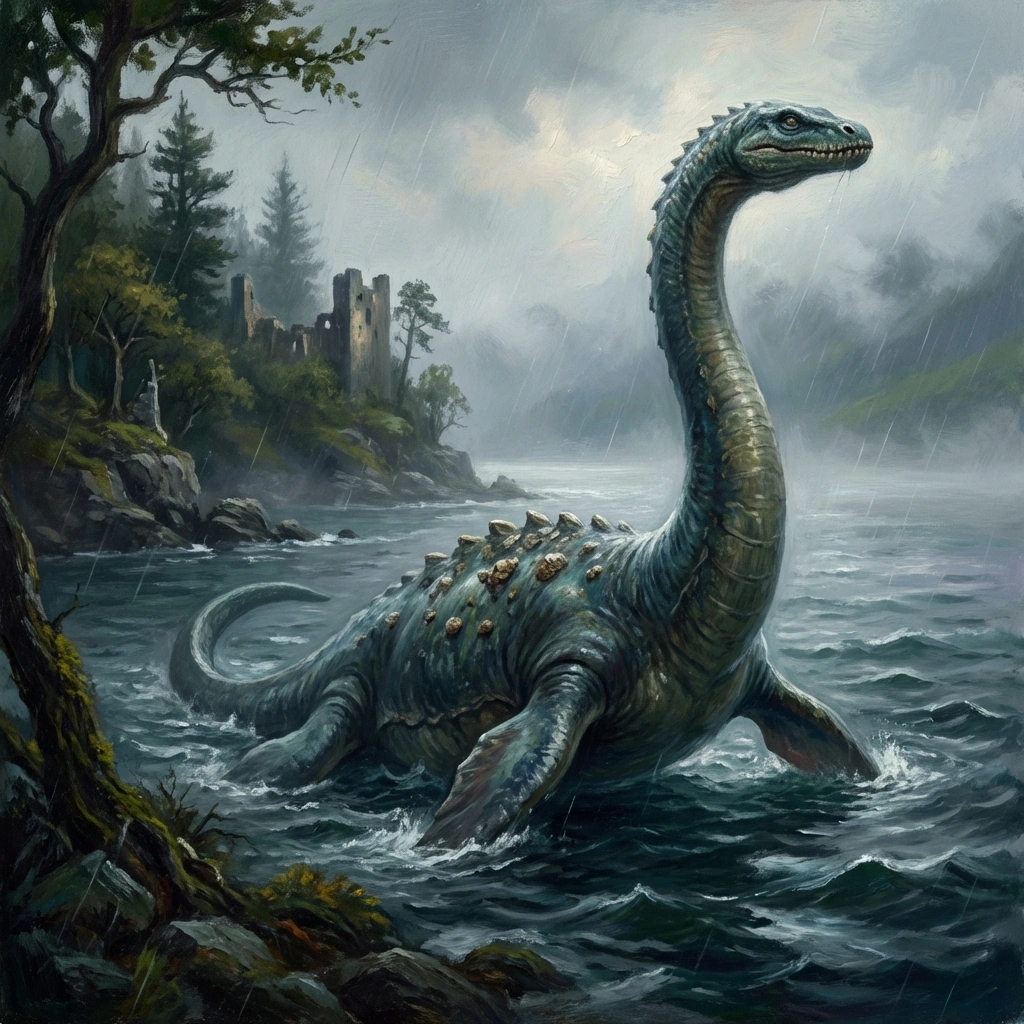
Loch Ness Monster
Loch Ness Monster is a cryptid beast often described as a large, elongate animal inhabiting the cold, peat-dark waters of Loch Ness. Smell: the air nearby carries the damp, earthy tang of peat and algae with a faint metallic ozone when the water is disturbed. Sound: reports note a low, resonant thrum beneath the surface and sudden, hollow splashes—less a roar than a deep, slow exhalation through water. Temperature: the loch itself is bone-cold year-round; the creature, however, is suggested to be warm-blooded—observers sometimes record a subtle warmth along waterline and a thin mist where warmer flesh meets colder loch air. Field-naturalist notes: skin is commonly recorded as dark, mottled and muscular beneath the surface, producing an undulating wake rather than the single high breach of oceanic whales.