The Bunyip: Stalker of the Billabong
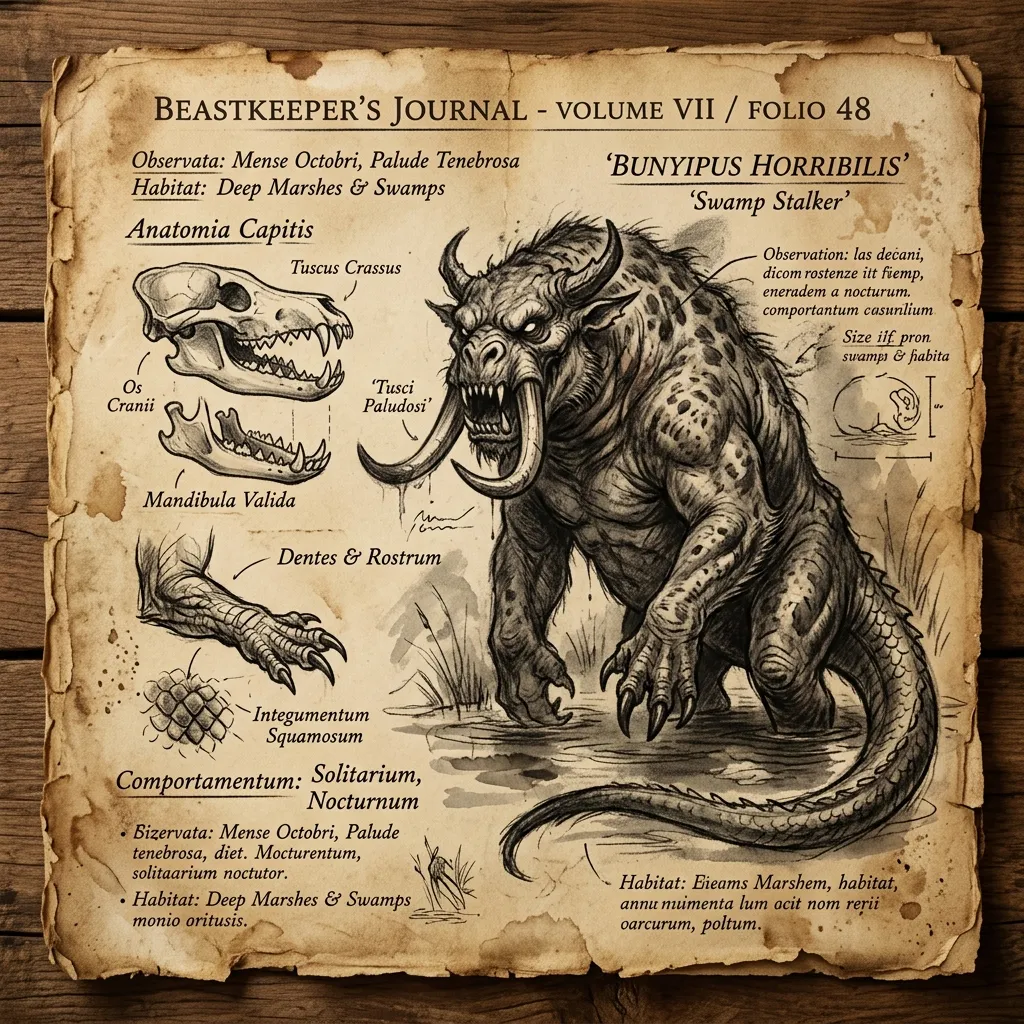
The Water's Edge
A Page from the Beastkeeper’s Journal
The Australian Outback is a landscape of harsh extremes, defined by blistering heat and seemingly endless red dirt. But it is the stagnant waters of its remote, muddy billabongs that hide its most primal, terrifying secrets. Local Indigenous elders had warned me of the dark spirit that inhabited this particular watering hole, claiming it had dragged three fully grown cattle beneath the surface in a single week.
I set up camp just as the sun dipped below the horizon, casting eerie, elongated shadows across the murky water. The frogs and insects, which had been deafening just moments before, suddenly fell deathly silent.
A massive bubble surfaced in the center of the billabong, followed by a low, guttural bellow that didn't just reach my ears—it vibrated aggressively through the muddy ground beneath my boots.
A Chimeric Nightmare
The legend of the Bunyip is deeply rooted in Aboriginal mythology, tracing back thousands of years. It is a malevolent water spirit that lurks in swamps, billabongs, creeks, and waterholes. In the dreamtime stories, the Bunyip is a terrifying predator that lies in wait for the unwary—particularly children or livestock—that wander too close to the water's edge.
Unlike creatures with a standardized appearance, descriptions of the Bunyip vary wildly across different Aboriginal nations and regions. Some describe it as a giant starfish-like creature, others as a massive dog-like beast with a duck's bill, and some as a horrifying amphibian hybrid.
Journal Note:
The variations in description suggest either multiple distinct species of megafauna that survived into human memory, or a creature capable of physical adaptation depending on its specific aquatic environment. Either theory is equally unsettling.
The Beast Surfaces
The water broke, revealing a monstrous creature pulling itself onto the muddy bank. It was a terrifying chimera—part amphibian, part mammalian predator. It was covered in dark, slick fur that resembled wet seaweed, and possessed a face that boasted a terrifying array of walrus-like tusks.
Water cascaded off its massive, heavily muscled shoulders as it dragged its immense bulk out of the water. Its dark eyes, lacking any pupils, scanned the shoreline with a chilling, predatory intelligence. The sheer physical power of the creature was undeniable; it could crush a man effortlessly.
The Echoes of Megafauna
Many modern cryptozoologists and paleontologists believe the legend of the Bunyip may be an incredibly ancient cultural memory of Diprotodon, a giant extinct marsupial that roamed Australia during the Pleistocene epoch. Others point to Quinkana, a giant terrestrial crocodile, or Megalania, a massive monitor lizard.
Aboriginal oral traditions are incredibly resilient, accurately preserving geographical and ecological data for over 10,000 years. If the Bunyip is a cultural memory of extinct megafauna, it is a testament to the survival and storytelling of the First Nations people.
Journal Note:
The creature didn't move like a reptile; it moved with the heavy, calculated grace of a mammalian predator. The tracks it left in the mud were bizarre—large, three-toed impressions that defied standard zoological classification.
A Final Reflection
The Bunyip locked eyes with me across the clearing. It didn't charge, and it didn't flee. It simply let out another bone-rattling roar—a territorial warning that shook the leaves from the gum trees. I slowly backed away, never breaking eye contact, my hand firmly on my flare gun. The creature watched me retreat until I was completely enveloped by the bushland, before turning and sliding silently back into the black water. The Bunyip was not just a myth; it was the absolute apex predator of this forgotten wetland.
Did You Know?
In the 1840s, a strange skull was discovered in the Murrumbidgee River. The discovery caused a massive media sensation, and the skull was widely displayed in museums as "The Skull of the Bunyip." It was eventually identified by naturalists as the disfigured skull of a foal or calf, but the sheer panic it caused showed how deeply the fear of the creature ran in early colonial Australia.
<div className="bg-surface border border-gray-700 rounded-lg p-6 my-8 text-center shadow-lg"> <h3 className="text-xl font-bold text-white mb-2">Want the Bunyip on your tabletop?</h3> <p className="text-content-dim mb-4">Support our expedition by grabbing the exclusive 3D printable STL figurine.</p> <a href="#fake-door-stl-bunyip" className="inline-block bg-blue-600 hover:bg-blue-500 text-white font-bold py-2 px-6 rounded-full transition-colors"> Download 3D Printable STL (Free) </a> </div>