The Kraken: Terror of the High Seas
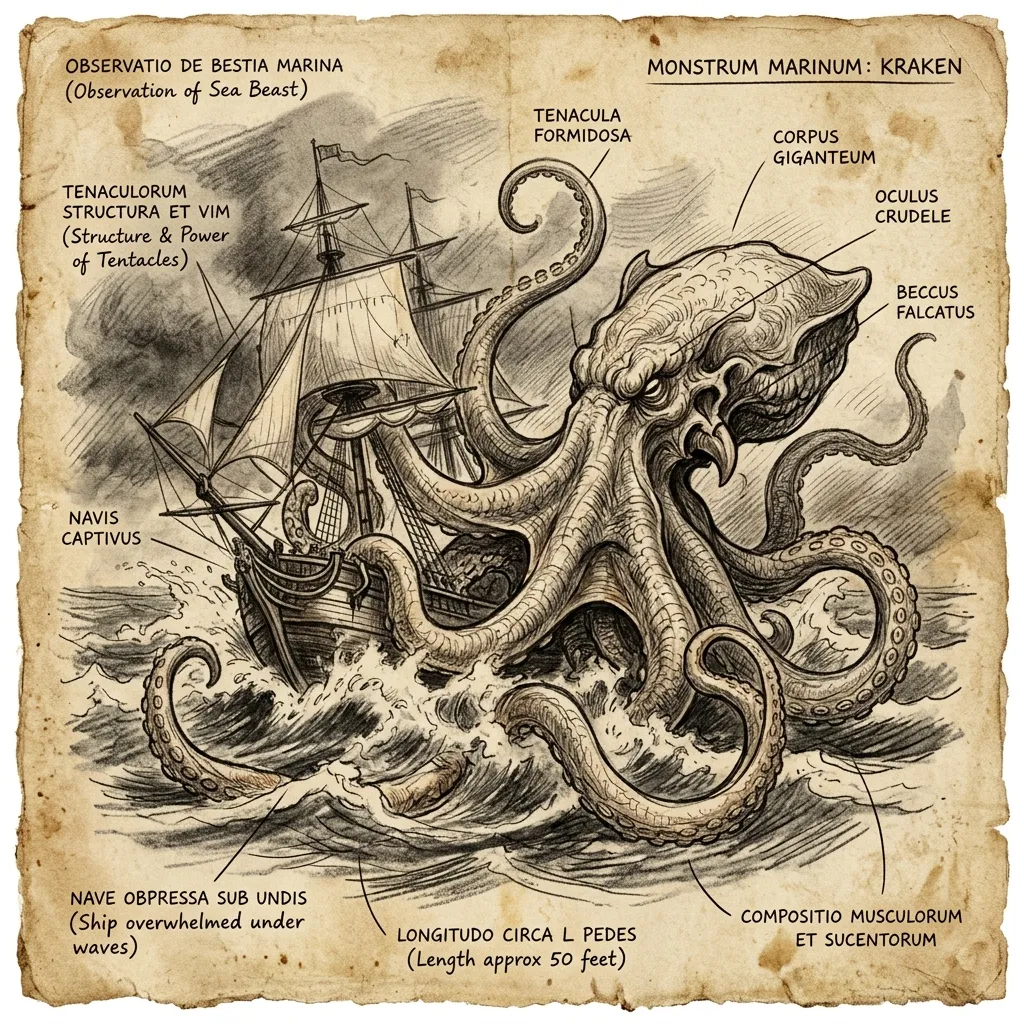
The Dead Calm
A Page from the Beastkeeper’s Journal
The storm passed hours ago, but the sea isn't right. The water has turned an unnatural, inky black, thick as molasses, deadening the sound of the hull cutting through the waves. More unsettling is the complete absence of life. The gulls that had been trailing our wake have vanished. The shoals of silver fish are gone. It is as if the ocean is holding its breath.
Then came the smell. A putrid, suffocating stench of rotting fish and ancient brine welled up from the deep. The ship shuddered, not from a wave, but from something massive displacing the water beneath us. I rushed to the port railing just in time to see a pale, rubbery column the size of our mainmast break the surface. It was covered in jagged, plate-sized suckers.
Origins of the Leviathan
The Kraken is the most feared monster in maritime folklore, originating from the sagas of Norse fishermen and sailors. It is described as a cephalopod of unimaginable proportions, capable of dragging entire ships down into the freezing depths of the ocean.
Unlike many mythical beasts that reside in specific enchanted forests or cursed mountains, the Kraken represents the vast, unknowable terror of the open sea. In the 13th-century Örvar-Oddr saga, a creature known as the Hafgufa is described, matching the Kraken's terrifying scale—a beast so large it was often mistaken for a string of islands.
Journal Note:
Sailors often claim the sea is a harsh mistress. But the sea is indifferent. The Kraken, however, is deliberate. It is the ocean's enforcer.
Abilities and Submersion
The Kraken's sheer size is its most devastating weapon. Its tentacles can wrap around the hull of a warship and crush it into splinters. But its deadliest tactic is often indirect.
When the Kraken decides to dive, its massive displacement creates a catastrophic whirlpool, a violent maelstrom capable of sucking down any vessel unfortunate enough to be trapped in its radius. Furthermore, it is said to excrete a dark, blinding ink that turns the water black and poisons the surrounding fish, ensuring nothing escapes its grasp.
The Fisherman's Mistake
An old tale speaks of a crew of Norwegian fishermen who found a spot where the fish were biting at an unbelievable rate. Their nets were overflowing. In their greed, they ignored the signs: the water growing shallower where there should have been no reef, and the sea turning an unnatural shade of brown.
They had not found a magical fishing ground. They were sailing directly over the rising back of the Kraken. The fish were fleeing to the surface in a desperate bid to escape the monster rising from below. By the time the fishermen realized their error, the beast's tentacles had already breached the surface, and their ship was pulled under in a matter of seconds.
Journal Note:
Nature always provides warnings. We are just too blinded by ambition to heed them until the water turns black.
A Final Reflection
The tentacle slid silently back into the abyss, and the ship rocked violently in its wake. We didn't fire the cannons. We didn't shout. The captain simply ordered the sails to be caught by whatever wind we could find, and we fled. The Kraken didn't want us; we were merely insects passing over its domain. But the smell of ancient brine lingered for days, a constant reminder of how small we truly are.
Did You Know?
Modern cryptozoologists and marine biologists believe that early legends of the Kraken were based on actual sightings of the Giant Squid (Architeuthis dux), which can grow up to 43 feet long and bears the scars of deep-sea battles with sperm whales.
<div className="bg-surface border border-gray-700 rounded-lg p-6 my-8 text-center shadow-lg"> <h3 className="text-xl font-bold text-white mb-2">Want the Kraken on your tabletop?</h3> <p className="text-content-dim mb-4">Support our expedition by grabbing the exclusive 3D printable STL figurine.</p> <a href="#fake-door-stl-kraken" className="inline-block bg-blue-600 hover:bg-blue-500 text-white font-bold py-2 px-6 rounded-full transition-colors"> Download 3D Printable STL (Free) </a> </div>