The Minotaur: Echoes in the Labyrinth
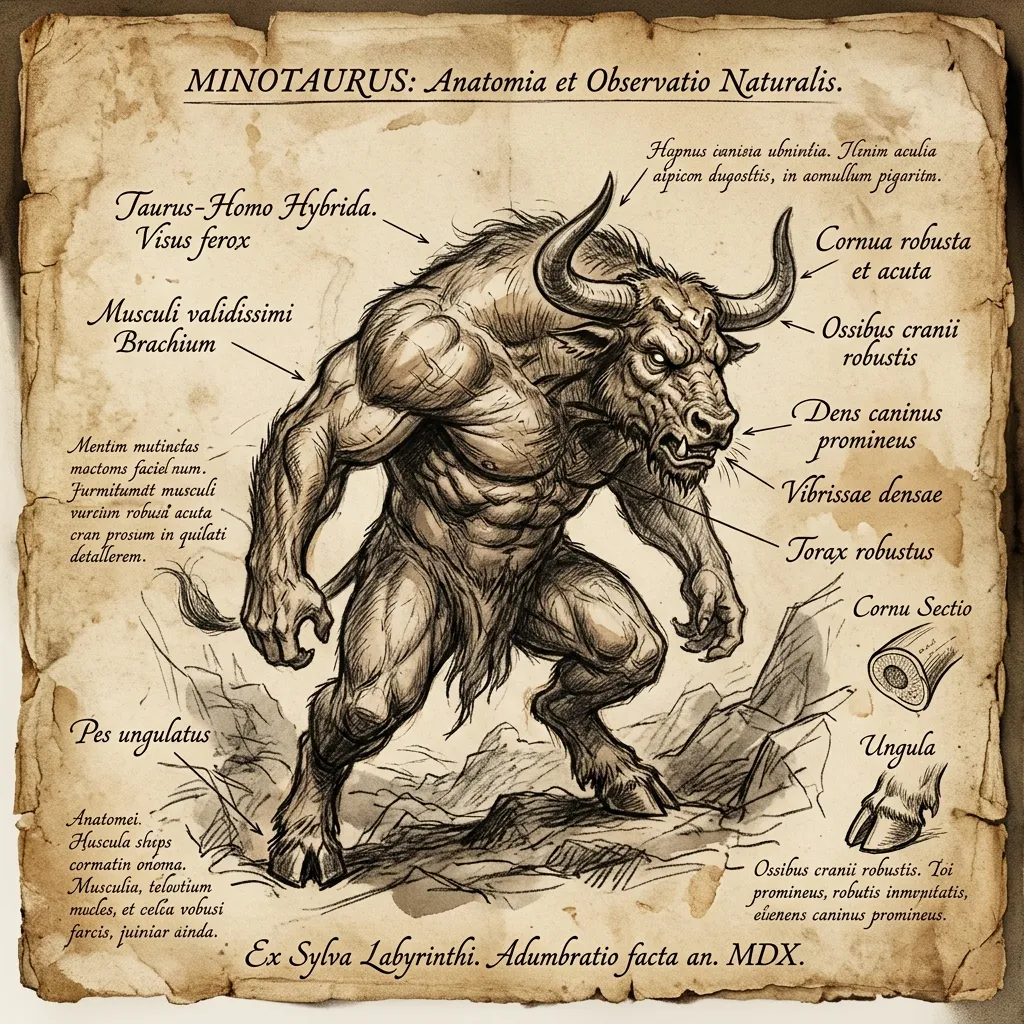
The Scent of Copper
A Page from the Beastkeeper’s Journal
The air in these ruins is heavy and stale, smelling faintly of ancient dust and rusted copper. I have been mapping these subterranean corridors beneath Crete for six hours, leaving a trail of chalk marks on the uneven limestone walls. The silence down here is oppressive, almost physical.
Then, the silence broke.
It wasn't a roar, but a deep, resonant snort, echoing off the stone walls from somewhere deep within the maze. The sound was followed by the heavy, dragging scrape of something massive moving through the dark. The vibration traveled up through the soles of my boots. I blew out my torch immediately, plunging myself into absolute darkness.
Origins of the Bull-Man
The Minotaur is one of the most tragic and terrifying monsters in Greek mythology. Born from a curse placed upon King Minos of Crete by Poseidon, the creature was the offspring of Minos's wife, Pasiphaë, and a magnificent white bull.
The resulting child, Asterion, possessed the body of a massive, muscular man and the head and tail of a bull. As he grew, his unnatural appetite for human flesh became impossible to control. To hide his shame and protect his kingdom, King Minos commissioned the master architect Daedalus to construct the Labyrinth—an inescapable maze of endless, twisting corridors designed to hold the beast forever.
Journal Note:
He was named Asterion, meaning 'the starry one.' He wasn't born a monster; he was forged into one by the sins of his father and the prison he was locked inside. Isolation breeds savagery.
The Endless Prison
The Labyrinth itself was as much a monster as the Minotaur. It was designed so flawlessly that even its creator, Daedalus, barely escaped after building it. The corridors were designed to disorient, with dead ends, looping paths, and identical archways that drove those trapped inside to madness before the beast ever found them.
To appease the gods and feed the monster, Athens was forced to send a tribute of seven young men and seven young women into the Labyrinth every nine years. Unarmed and terrified, they were left to wander the dark until the Minotaur claimed them.
The Thread of Ariadne
The reign of the Minotaur ended with the hero Theseus. Volunteering as a tribute, Theseus won the heart of King Minos's daughter, Ariadne. Desperate to save him, she gave Theseus a ball of magical thread (a clew) to unwind as he ventured into the maze, ensuring he could find his way back out.
Deep in the heart of the Labyrinth, Theseus confronted the Minotaur. Accounts vary—some say he used a concealed sword, others say he beat the beast to death with his bare hands. Following the thread back to the entrance, Theseus emerged victorious, ending the grisly tributes forever.
Journal Note:
But what if the Labyrinth is not empty? What if the myth of Theseus was just a story told to comfort the Athenians, while the true horror remains locked in the dark, still wandering the endless stone?
A Final Reflection
I pressed my back against the cold stone, holding my breath. The dragging footsteps grew louder, and a shadow darker than the surrounding pitch blackness eclipsed the corridor ahead. I didn't wait to see the horns. I turned and felt my way back, hand over hand along the wall, following my chalk marks to the surface. Some tombs should not be disturbed.
Did You Know?
The word "clue" originates from the Greek myth of the Minotaur. It evolved from the word "clew," which meant a ball of thread or yarn—specifically the one used by Theseus to navigate the Labyrinth.
<div className="bg-surface border border-gray-700 rounded-lg p-6 my-8 text-center shadow-lg"> <h3 className="text-xl font-bold text-white mb-2">Want the Minotaur on your tabletop?</h3> <p className="text-content-dim mb-4">Support our expedition by grabbing the exclusive 3D printable STL figurine.</p> <a href="#fake-door-stl-minotaur" className="inline-block bg-blue-600 hover:bg-blue-500 text-white font-bold py-2 px-6 rounded-full transition-colors"> Download 3D Printable STL (Free) </a> </div>