The Tengu: Ascetic of the High Peaks
The Mountain's Test
A Page from the Beastkeeper’s Journal
The ascent to the abandoned Yamabushi monastery was treacherous, the path choked with ancient, twisted pines and swirling, icy mist. The air grew thinner with every step, and the profound silence of the high peaks was heavy and oppressive. I was seeking the Tengu, the legendary avian spirits of Japanese folklore, known equally for their unparalleled martial prowess and their dangerous, unpredictable trickery.
As I finally reached the stone courtyard of the ruined temple, the howling wind suddenly died, leaving a suffocating stillness.
A sudden, forceful gust sent dead leaves spiraling into a miniature cyclone, and I looked up to see a figure perched impossibly on the delicate, curved eaves of the temple roof. It was watching me.
Spirits of the Blade and Wind
Tengu are a fascinating contradiction in Japanese mythology. Originally depicted as terrifying, disruptive demons who possessed the bodies of women to seduce holy men or kidnapped children, they eventually evolved into protective, if highly dangerous, mountain deities.
They are deeply associated with the Yamabushi, the ascetic hermits who practice Shugendō (a highly syncretic religion blending Shinto, Buddhism, and Taoism) in the mountains. Tengu are considered absolute masters of martial arts and swordsmanship. In legend, many famous samurai and historical heroes, such as Minamoto no Yoshitsune, were supposedly trained by the Tengu king himself.
Journal Note:
The creature emanated an aura of intense, highly focused discipline. It did not project the raw, chaotic malice of a predator, but rather the intimidating presence of a master evaluating a deeply flawed student.
Daitengu vs. Kotengu
There are two primary classifications of these spirits. The Kotengu (or Karasu-Tengu) are the older, more animalistic depictions, resembling bipedal crows or birds of prey with strong beaks.
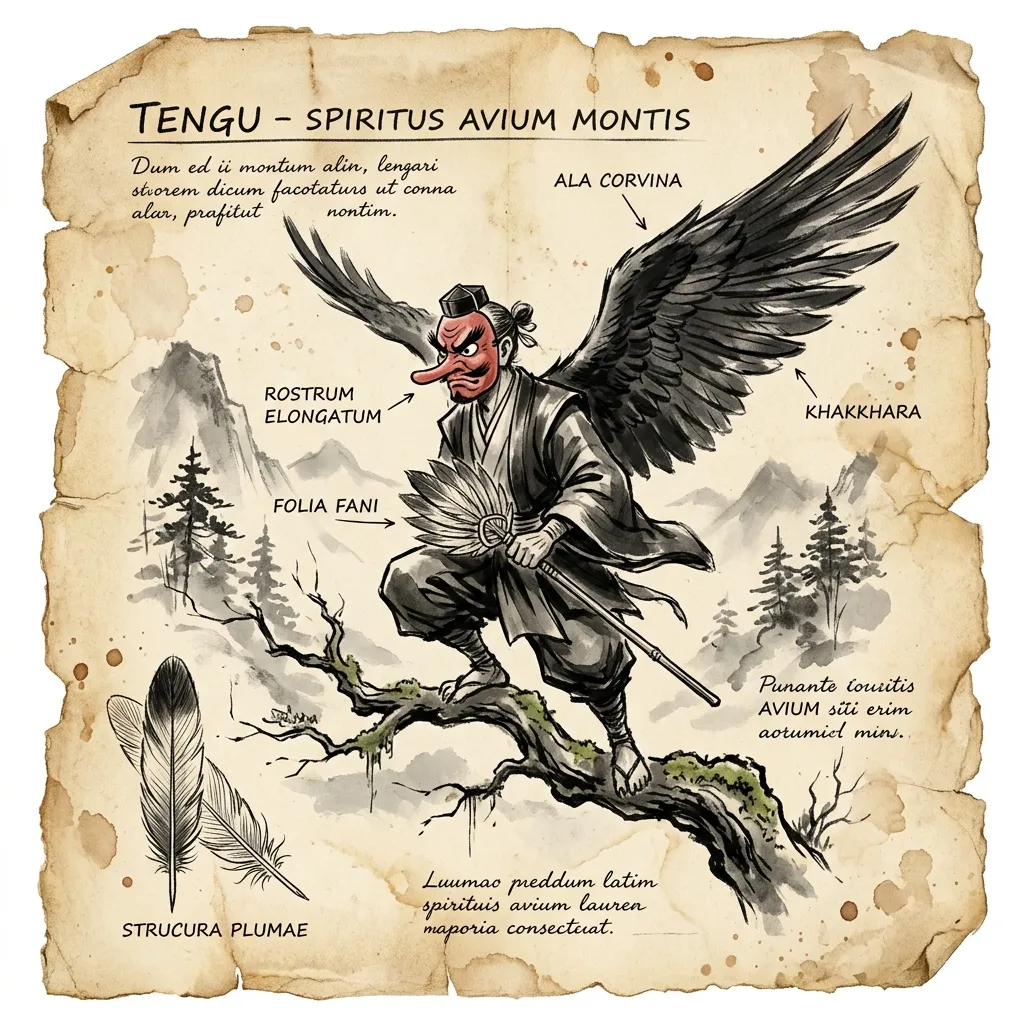
The figure perched before me, however, was clearly a Daitengu (Great Tengu). It was clad in the traditional robes of a Yamabushi ascetic, complete with the small hexagonal hat (tokin). From its back sprouted magnificent, iridescent raven wings. Its face was a terrifying, bright red mask featuring an unnaturally long nose (hanadaka), and its piercing, glowing eyes locked onto mine with an unsettling, judgmental intensity.
The Trickster's Illusions
Tengu are renowned for their supernatural abilities, particularly their power to manipulate wind, teleport, and cast incredibly realistic illusions. They use these powers to punish the arrogant, the greedy, and those who disrespect the sacred mountains.
Journal Note:
I checked my compass. The needle was spinning wildly, and the temperature dropped ten degrees in a matter of seconds. The physical space around the temple felt warped, as if the geometry of the courtyard was subtly shifting.
A Final Reflection
The creature didn't speak aloud, but a booming, resonant voice echoed directly in my mind, challenging my resolve and mocking my intrusion into its sacred domain. It held a magical feather fan (hauchiwa), capable of stirring up great winds. With a sudden, forceful beat of its massive wings, the Tengu launched itself into the fog. It didn't fly away; it simply vanished into the mist instantly, leaving me with the distinct impression that I had been tested, judged, and perhaps, found wanting. I bowed to the empty roof and began the long descent.
Did You Know?
The long, phallic nose of the Daitengu is actually a later evolution of the myth! Early depictions of Tengu always featured bird beaks. As the spirits became more humanized and associated with ascetic monks over the centuries, the beak gradually morphed into the incredibly long, distinctive nose we recognize today, often used to symbolize pride and arrogance.
<div className="bg-surface border border-gray-700 rounded-lg p-6 my-8 text-center shadow-lg"> <h3 className="text-xl font-bold text-white mb-2">Want the Tengu on your tabletop?</h3> <p className="text-content-dim mb-4">Support our expedition by grabbing the exclusive 3D printable STL figurine.</p> <a href="#fake-door-stl-tengu" className="inline-block bg-blue-600 hover:bg-blue-500 text-white font-bold py-2 px-6 rounded-full transition-colors"> Download 3D Printable STL (Free) </a> </div>