The Yeti: Guardian of the High Peaks
A Cold Reception
A Page from the Beastkeeper’s Journal
The wind up here doesn't just blow; it screams. Every breath feels like swallowing broken glass, and the cold seeps through layers of wool and down, nesting deep in your bones. I had been tracking the ridgeline for three days, following whispers from a Sherpa village about shadows moving against the snow at dusk.
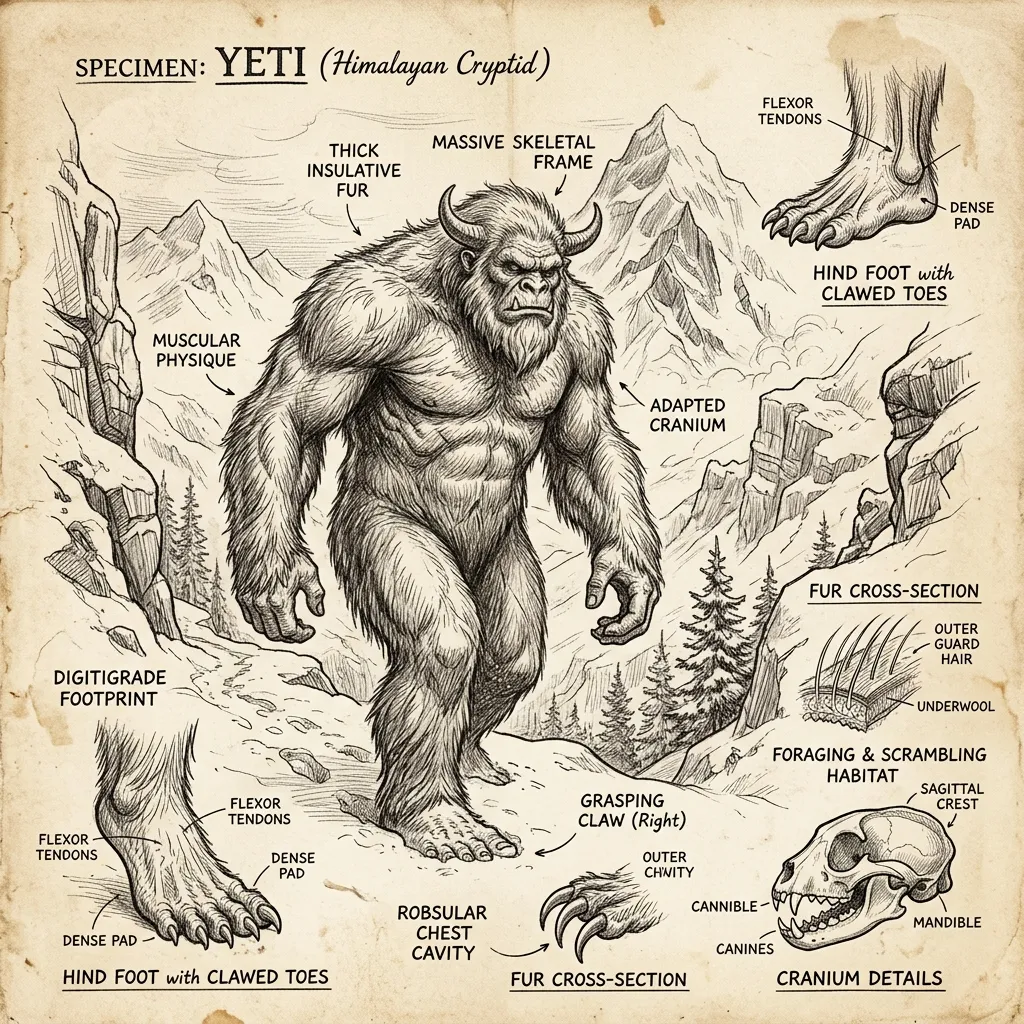
Then, I saw it. Not the creature itself, but its mark. A footprint—impossibly wide, pressed deep into fresh powder, the toes distinctly splayed.
I knelt beside it, the howling wind suddenly feeling very distant. I was being watched. The hairs on the back of my neck stood up, and as I scanned the whiteout conditions above me, I saw a massive, lumbering silhouette disappear behind a crag.
Origins of the Snow Giant
The Yeti, often referred to as the Abominable Snowman, is deeply ingrained in the folklore of the Himalayas, particularly among the Sherpa and Tibetan people. To them, the Yeti is not a monster to be hunted, but a spiritual entity—a guardian of the high places where humans are not meant to tread.
The name "Yeti" likely derives from the Tibetan word yeh-teh, meaning "small manlike animal," though descriptions often depict it as towering over any human. It is said to be a bipedal creature, covered in thick, dark or reddish-brown hair (despite popular media often depicting it as white).
Journal Note:
Western culture portrays the Yeti as a ferocious beast, but local tales often speak of a solitary, almost tragic figure. Is it a lost branch of humanity, or a physical manifestation of the mountain's wrath?
Abilities and Nature
The Yeti's greatest strength is its complete mastery of its environment. It can navigate treacherous ice falls and sheer cliffs with impossible agility. It is said to possess immense strength, capable of hurling boulders to deter intruders, and a piercing whistle that cuts through the roar of an avalanche.
Some legends suggest the Yeti is nocturnal and avoids humans at all costs. Seeing one is often considered an ill omen, a warning that the traveler has pushed too far into the sacred domains of the mountains.
The Whistling Warning
A local guide shared a story of his grandfather, a trader who once sought a shortcut through a high pass during a looming storm.
As the snow began to fall, the trader heard a sharp, high-pitched whistle echoing off the icy walls. Ignoring it, he pressed on. The whistle sounded again, closer this time, accompanied by the distinct sound of heavy snow crunching under massive feet. Through the blizzard, a towering figure blocked the pass. It didn't attack; it simply stood there, an immovable force of nature, pointing back down the mountain.
The trader took the warning and turned back. The next day, an avalanche wiped out the entire pass he had intended to cross.
Journal Note:
It didn't attack him. It saved him. The Yeti isn't a predator; it's a warden. It keeps us out of places that would otherwise kill us.
A Final Reflection
I didn't follow the silhouette behind the crag. The cold was setting in, and the footprint was proof enough for me. The Yeti doesn't need to be captured or studied. It exists as a reminder that there are still wild, untamable corners of this earth where humanity is merely a guest.
Did You Know?
The first highly publicized footprints of the Yeti were photographed in 1951 by British mountaineer Eric Shipton. The photos sparked a global obsession with the creature that continues to this day.
<div className="bg-surface border border-gray-700 rounded-lg p-6 my-8 text-center shadow-lg"> <h3 className="text-xl font-bold text-white mb-2">Want the Yeti on your tabletop?</h3> <p className="text-content-dim mb-4">Support our expedition by grabbing the exclusive 3D printable STL figurine.</p> <a href="#fake-door-stl-yeti" className="inline-block bg-blue-600 hover:bg-blue-500 text-white font-bold py-2 px-6 rounded-full transition-colors"> Download 3D Printable STL (Free) </a> </div>