Barong: The Lion King
The King of Spirits
In the temple courtyards of Bali, the air smells of incense and impending violence. The gamelan orchestra plays a frantic, clashing rhythm. This is not a call to prayer. It is a summons for war.
The villagers are calling for Barong, the King of the Spirits. And when he arrives, shaking his golden mane and snapping his wooden jaws, the atmosphere shifts from fear to holy awe. He is the only thing standing between the island and total spiritual collapse.
The Lord of the Forest
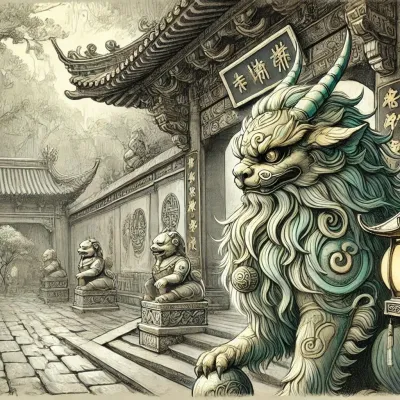
Barong is a chaotic, colorful guardian. He manifests as a four-legged creature, most commonly a lion (Barong Ket), though boar and tiger variations exist.
His appearance is designed to dazzling evil spirits. He has a red face with bulging eyes, a beard made of human hair (imbued with spiritual power), and a coat covered in mirrors and gold leaf. When he moves, he prances and snaps with an energy that transcends the physical actors inside the costume. He is not a static idol. He is a living, breathing vessel of divine protection.
The Eternal Stalemate
Barong exists in opposition to Rangda, the Demon Queen. Their conflict is the central narrative of Balinese spirituality.
Crucially, neither can ever truly win. They represent Rwa Bhineda—the sacred balance of light and dark. If Barong defeated Rangda permanently, the balance would break. So they fight in an eternal loop. Rangda spreads plague. Barong heals it. Rangda curses. Barong protects. It is a gridlock of cosmic proportions.
The Kris Dance
The most terrifying demonstration of Barong's power occurs during the Keris Dance.
Rangda casts a spell on Barong's soldiers, entrancing them and commanding them to commit mass suicide. The men turn their wavy-bladed daggers (kris) against their own chests, pushing with full force. But Barong roars. His magic washes over them, hardening their skin to the density of steel. The daggers bend. The men scream in trance, fighting a psychological war, but their bodies remain uncut.
Interaction Protocols
Barong is benevolent, but he is a spirit of raw power.
- Respect the Trance: When the dance is active, the participants are not acting. They are possessed. Do not interfere with the ritual.
- The Beard: The beard of the Barong mask is considered the most sacred part, often made from the hair of high priests. Touching it is strictly forbidden.
- Sanctuary: If one feels the presence of black magic or the gaze of Rangda, running toward the Barong figure offers immediate spiritual shielding.
The Final Warning
The tourists leave, and the masks are stored away, but the war does not end with the performance. In the deep jungle, the balance is still precarious. The Barong is not a costume; he is a sentinel. The mirrors on his coat are still flashing in the moonlight because the darkness never sleeps, and Rangda is always watching.